<!-- .slide: data-background-color="var(--divider-bg, var(--slide-bg))" --> <div class="brand"> </div> <div class="eyebrow"> EES 2026 LILLE · STRAND S01 NEW METHODS · SESSION 281 </div> <div class="headline"> Interrogating evaluation: <span class="teal">a live experiment</span> and conversation </div> <div class="subhead"> with a little help from AI </div> <div class="byline"> Silva Ferretti, independent consultant · Steve Powell, Causal Map Ltd </div>
<!-- .slide: data-background-color="var(--divider-bg, var(--slide-bg))" --> # Where is evaluation going?
## What we are about to do <div class="lead"> Ninety minutes, one question, and two ways of answering it. </div> <div class="cascade-5"> - You talk to an AI interviewer about where evaluation is going - We look at its rapid synthesis together, as an interim draft - Some tables talk it through with an AI moderator, others without AI - Tables report back, and we compare - We ask what each method made easier, harder or invisible </div>
## A declaration of interest <div class="callout"> Steve develops the AI interviewer we are using today, Qualia, so he has an interest in it. </div> There are other AI interviewing apps, and we will say briefly how they differ. What we are testing today is the method.
## From the field: South Sudan <div class="panel"> <span class="hl yellow">Silva to fill: the South Sudan interviews, and the workshop that followed straight after.</span> </div>
## Some other uses, more or less structured <div class="columns align-middle"> <div style="width:45%"> - **International Evaluation Academy**: a consultation across its network on evaluation and transformation, in place of a text-box questionnaire (2026) - **VIB, the Flanders Institute for Biotechnology**: over 100 PhD students on their journey, the challenges and the support (2025) - **Duoc UC, Chile**: 32 students in STEM programmes, in Spanish, on the gender gaps they meet from study into work (2024) </div> <div style="width:55%"> 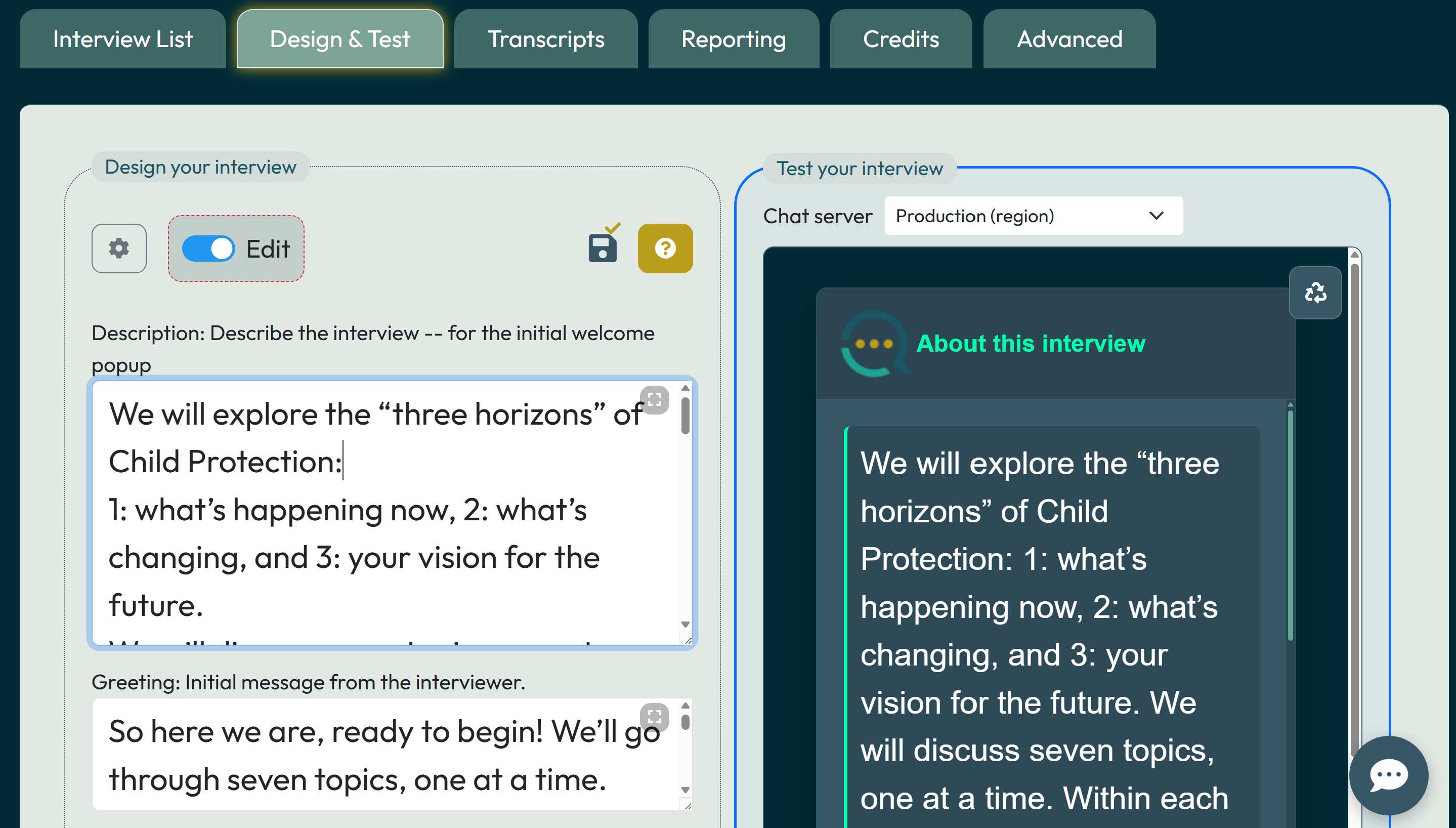 </div> </div>
<!-- .slide: data-background-color="var(--divider-bg, var(--slide-bg))" --> # Your turn: the interview
## Where is evaluation going? <div class="columns align-middle"> <div style="width:40%"> <div class="scale-75">  </div> </div> <div style="width:60%"> Scan the code, or go to `chat1.qualiainterviews.com/?interview=ees26-where-is-evaluation-going` Pick your interviewer: - <span class="chip blue">neutral</span> - <span class="chip orange">challenging</span> - <span class="chip green">exploratory</span> - <span class="chip grey">academic</span> - <span class="chip blue">surprise me</span> Talk or type. About twelve minutes. </div> </div>
<!-- .slide: data-background-color="var(--divider-bg, var(--slide-bg))" --> # What did the AI hear?
## The rapid synthesis <div class="lead"> An interim artefact, not a conclusion. </div> <span class="hl yellow">Paste or show the live synthesis here.</span> It reads the interviews on three fronts: whether evaluation needs a transformation or improvement; the future people want, what in today's evaluation holds it back, and what is already moving (Three Horizons); and what being interviewed by an AI was like.
## What does it miss? <div class="callout"> You can make a convincing synthesis with AI. <span class="flare pink">What does it leave out?</span> </div> <div class="fragment"> Whose stories are there, and whose are flattened? </div> <div class="fragment"> What would you have asked that it did not? </div> <div class="fragment"> You told the interviewer what it missed. Does the synthesis hear that? </div>
<!-- .slide: data-background-color="var(--divider-bg, var(--slide-bg))" --> # At your tables
## Two kinds of table <div class="cards cols-2"> <div class="card"> **With an AI moderator**  `chat1.qualiainterviews.com/?interview=ees26-tables` </div> <div class="card"> **No AI** Talk it through as a table, with paper and pen. </div> </div> The AI moderator has read a running summary of the room's interviews. One person types for the table; everyone talks. About twenty-five minutes; keep the last five for your report back.
## Questions for every table - What do you recognise in the room's synthesis, and what is missing or wrong? - Which one change in where evaluation is going matters most, and why that one? - What should evaluators start doing, or stop doing? - Where do you disagree? - Agree two or three points to report back, including any disagreement.
## Want to build your own? <div class="columns align-middle"> <div style="width:40%"> <div class="panel"> If you would like to set up an interview for your own work, we can help you at your table. </div> Sign up and design your interview at `manage.qualiainterviews.com` <div class="scale-40">  </div> More about Qualia at `qualiainterviews.com` </div> <div style="width:60%"> 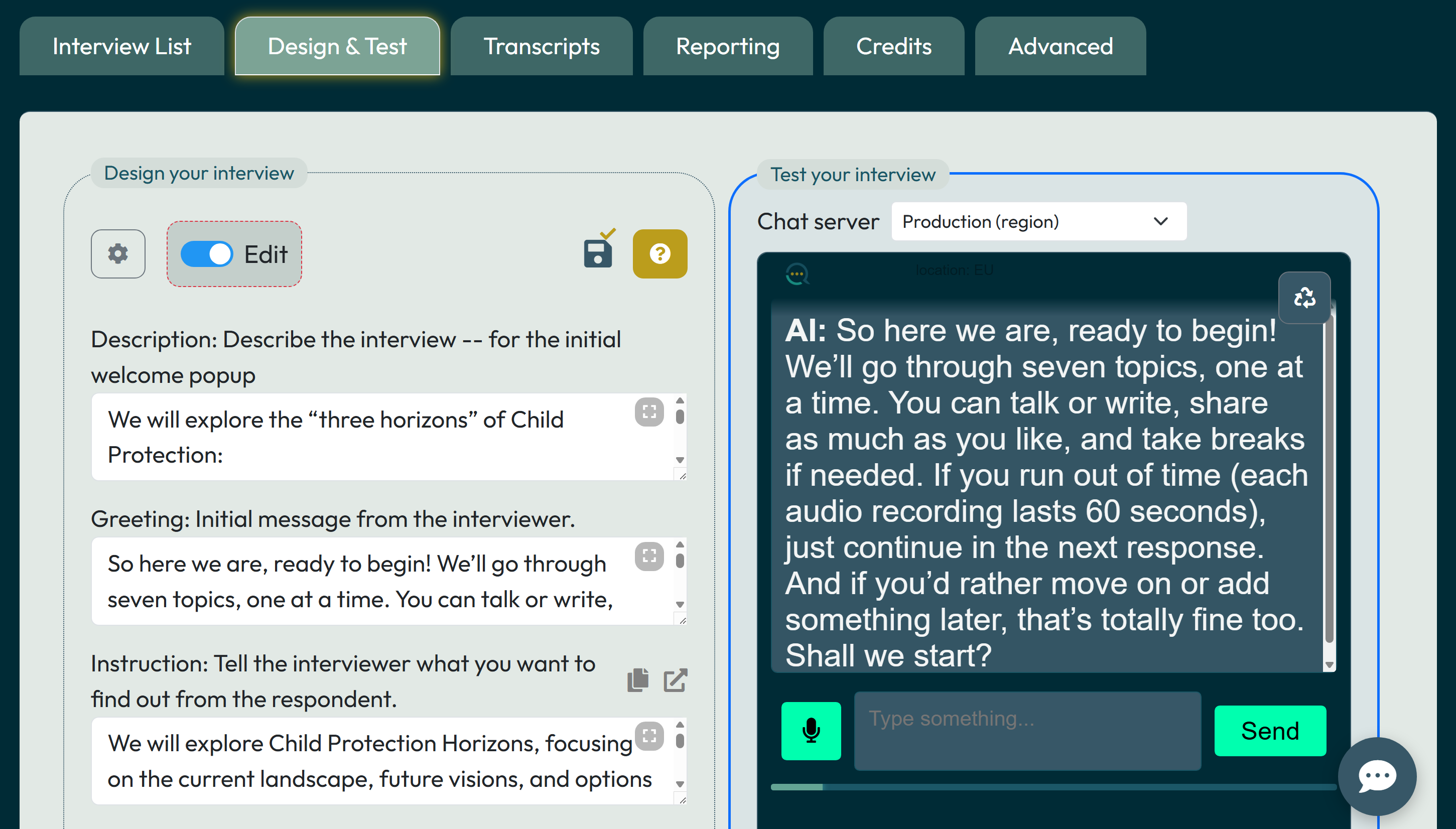 </div> </div>
<!-- .slide: data-background-color="var(--divider-bg, var(--slide-bg))" --> # Reporting back
## Two questions for each table <div class="cards cols-2"> <div class="card"> **Where is evaluation going?** And what is to be done? </div> <div class="card"> **What did the method do?** What did it make easier, harder, more visible or less visible? </div> </div>
<!-- .slide: data-background-color="var(--divider-bg, var(--slide-bg))" --> # Wrap-up
## What just happened <div class="cascade-3"> - The interview we just did was a real-time evaluation - Interviewing can be the boring part, and the AI took it on - It all means nothing if it does not change our minds along the way </div>
## Thank you <div class="columns align-middle"> <div> **Silva Ferretti** silva.ferretti@gmail.com </div> <div> **Steve Powell** steve@causalmap.app · qualiainterviews.com <div class="scale-40">  </div> `causalmap.app/events/ees2026` </div> </div>
<!-- .slide: data-background-color="var(--divider-bg, var(--slide-bg))" --> # In our back pockets
## The management side  Designing, testing and reading the transcripts, live.
## When to use an AI interviewer, and when not <div class="columns"> <div> **Use it** - When you do not know exactly what to ask - For less structured, exploratory conversations - When respondents speak different languages - To reach more people than interviewers could </div> <div> **Think twice** - When a questionnaire would do - When you have many specific questions - With sensitive topics or vulnerable groups - When people need a human in the room </div> </div> <div class="panel"> Face-to-face interviews give depth to a few people; questionnaires give reach without depth. Where does AI interviewing sit? </div>
## Five interviewers, one instruction Each of you chose how to be interviewed. The difference is one line of the instruction. <div class="cards cols-2 scale-80"> - **Neutral.** Calm and unobtrusive. Clear, direct questions; probe only to clarify or get examples. No opinions or interpretations. - **Challenging.** A critical colleague. Politely sceptical; spot contradictions, question assumptions, challenge claims that sound good but lack substance. - **Exploratory.** A curious ethnographer. Invite stories and details, follow threads I mention in passing, look for what is surprising or overlooked. - **Academic.** A demanding professor. Probe definitions, assumptions and the logic of arguments; link to wider debates without lecturing or inventing references. </div> "Surprise me" picks one without saying which, and asks you to guess at the end. Did the style change what you said? <span class="caption">From the interview's instruction, slightly shortened.</span>
## What the interviewer is told <div class="columns"> <div> **The researcher's instruction** - The aims and the questions, in plain language - Sections marked by importance: some are asked whatever happens, some can go when time is short - The style, the languages, the tone </div> <div> **Rules no instruction can remove** - Raise a safeguarding alert when someone discloses a risk of harm - Put the respondent's time before any target - Ask before ending the interview - Use the markers the app reads for sections, progress and closed questions </div> </div> <div class="panel"> Writing the instruction is the research design. Testing it is the piloting. </div>
## What the AI moderator read - A summary of the room's individual interviews, about 400 words, written by a separate AI call - First written once five interviews had at least five messages each, then rewritten as they grew - Paraphrase only: no quotes, no names, nothing that could identify anyone - Test runs and archived transcripts are left out - The tables' instruction says what to do with it: share its main points, then ask what is missing or wrong
## How we tested today's interviews <div class="bignums scale-75"> - <span class="fig">**7**</span> simulated respondents at once, in five languages, one speaking and one on a phone: all reached the end in their own language - <span class="fig">**30**</span> conversations at once: none failed; half the replies came within 2.5 seconds - <span class="fig">**12</span> of 12** rehearsed table conversations opened with the room's summary; the first wording managed 2 of 6, so we rewrote it - <span class="fig">**6</span> of 6** "Surprise me" interviews asked for the guess and revealed the style </div> Simulated respondents test the instrument, not the findings.
## Are people more candid with a machine? <div class="callout"> In health-screening interviews with a virtual human, people who believed it was automated, rather than operated by a person, reported less fear of disclosing and less impression management, and observers rated them more willing to disclose. </div> <span class="caption">Lucas, Gratch, King and Morency (2014), *Computers in Human Behavior* 37, 94–100.</span> <div class="fragment"> - Probably strongest on sensitive or embarrassing topics - It may reverse when people suspect they are being watched or recorded - Does it hold for evaluators talking about their own field? </div>
## Languages and channels <div class="cards cols-2 scale-80"> - **97 languages** in the language menu. - **Spoken dialects.** For seven Arabic dialects the interviewer is told to write the spoken variety, not Modern Standard Arabic. - **Talk or type.** Speech is transcribed in the same region as the rest of the data. - **Where people already are.** A web link on any phone, or WhatsApp and Telegram for EU interviews. </div>
## Data, privacy and safeguarding <div class="cards cols-2 scale-75"> - **EU mode.** A separate database, and every AI call made inside the EU. Today's interviews run there. - **Anonymous by default.** The interviewer asks people not to give names, and flags it when they do. - **Redaction, if you want it.** Names and other identifying details are replaced before anything is stored, and the respondent sees what was kept. - **Safeguarding alerts.** When someone discloses a risk of harm, the interview's owner and editors get an email straight away. - **Retention.** You choose how long transcripts are kept. They are then deleted automatically, and the owner is sent a receipt. </div>
## A first round of Outcome Harvesting: KLAR!, Austria Climate change adaptation in Bad Ischl and Ebensee, two pilots in 2024 and 2025. <div class="bignums"> - <span class="fig">**19**</span> of 39 invited stakeholders took part, most for 20 to 30 minutes - <span class="fig">**38**</span> outcome statements, 6 of them meeting the SMART criteria as they stood - <span class="fig">**32**</span> leads for human follow-up and validation </div> "It was fun writing with you." · "Repetition of questions somewhat tedious." · "I prefer communicating with humans." <span class="caption">Birgit Müllegger, Konny Rassmann and the Causal Map team; presented at UKES 2026.</span>
## From transcripts to causal maps: Duoc UC, Chile - 50 invited, 32 interviewed by Qualia in Spanish, on the gender gaps women meet from STEM study into work - AI coded every causal claim with no codebook, inventing its own labels in Spanish - 251 causal links, put together into one map in Causal Map <div class="panel"> The interview is half the job. The transcripts still need analysing, by people, or by AI whose work people can check. </div>